In preparation · one volume
A grandfather, a shotgun, and a boy in coastal Carolina
Two readers named Robert Ruark to us without being asked. They know each other, which makes it weaker evidence than it first looked — and we would rather say so.
We asked people what book they miss. Most named something they half-remembered. One reader named Ruark, and added that he still reads him, and that one of his children has taken to him too. Another named Willard Price — different author, identical hunger. Boy, outdoors, an adult who knows things, a world where the weather matters.
We first wrote that up as two independent votes. It is not: the two of them are in the same group, so it may be one enthusiasm travelling rather than two people arriving at the same place. That is a real difference and it cuts the signal down. What survives it is that both named a specific author they still read, rather than a book they half-remember — and nobody else has named this shelf at all.
Which Ruark, though
This is worth getting right, because it is the obvious way to get Ruark wrong. He is best remembered for Africa — Horn of the Hunter, Something of Value, Uhuru. Those are not these.
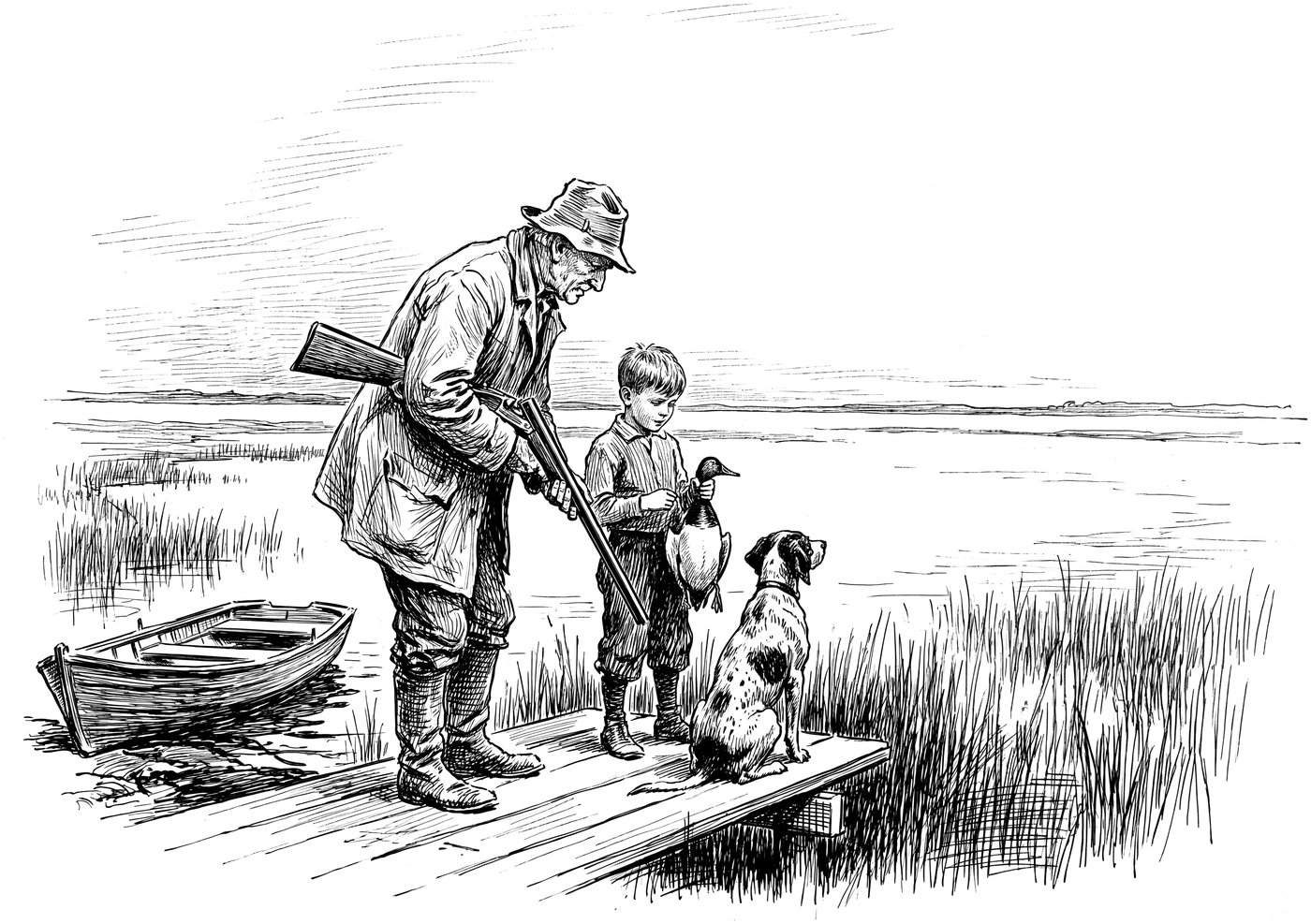
The Old Man and the Boy (1957) and its sequel The Old Man's Boy Grows Older (1961) are set on the coast of North Carolina, around Southport and the Cape Fear River, where Ruark grew up.1 They were assembled from a column he wrote for Field & Stream. There is no Africa in them. There is a grandfather, a boy, a shotgun, a boat, and a long argument with the world about how to behave.
The second book is the one we have set. Ruark died on 1 July 1965, in London.2
What we have actually done
The text was scanned from a copy of the 1961 Holt, Rinehart and Winston edition and rebuilt page by page: 95,089 words, thirty-one chapters, and 989 individual human decisions about words the machine got wrong or thought it got wrong.
That number is the honest cost of this work and we would rather quote it than pretend the thing assembles itself. A scanner reads soliders for soldier's and is perfectly confident about it. Somebody has to sit there and say no.
The proofreading burden attaches to the scanning, not to the publishing. Where somebody has already done it properly, we inherit their work and say so. Where nobody has, it is ours to do, and it is a weekend per book.
Why it is on the list
Because it is out of print in any edition you would want to own, because two readers asked for it unprompted, and because it is the kind of book that gets handed down rather than bought — which is the only kind we are interested in.
R490, text only, and not printed yet. Ruark died in 1965, so the words are free to print in South Africa. The drawings are not: they are Walter Dower’s, and nobody can tell us when he died.
We looked properly. The only dates in circulation — 1883 to 1934 — belong to a different man, a Syracuse painter buried in Oakwood Cemetery, whose auction lots happen to be fly-fishing and North Carolina scenes. It is a convincing trap and it is the wrong Dower. The Library of Congress record for the 1957 edition names him in one line of the title page and gives him no dates at all. South African law gives us no way to proceed without them, so his drawings are not in this book.
We would rather print the book without them and tell you why than print them and hope nobody checks.
Sources
- Dictionary of North Carolina Biography: Robert Ruark, "29 Dec. 1915–1 July 1965"; The Old Man and the Boy (1957), The Old Man's Boy Grows Older (1961); boyhood at Southport, North Carolina. NCpedia
- Date and place of death corroborated: Robert Ruark.
- Publisher and year of the sequel confirmed against the copyright page of the scanned first edition, Holt, Rinehart and Winston, 1961. North Carolina Literary Hall of Fame